Download all songs.

All songs in one large zip file for your very personal device.
Powder Rag
Dallas Rag
Maple Leaf Rag
Unknown Fragment
Angie
Early Ragtime Guitar Medley
Harlem Rag
Windy and Warm
St. Louis Tickle
Buckdancers Choice
Sweet Georgia Brown
Thames Street Tickle
John Bealle
Ragtime Guitar
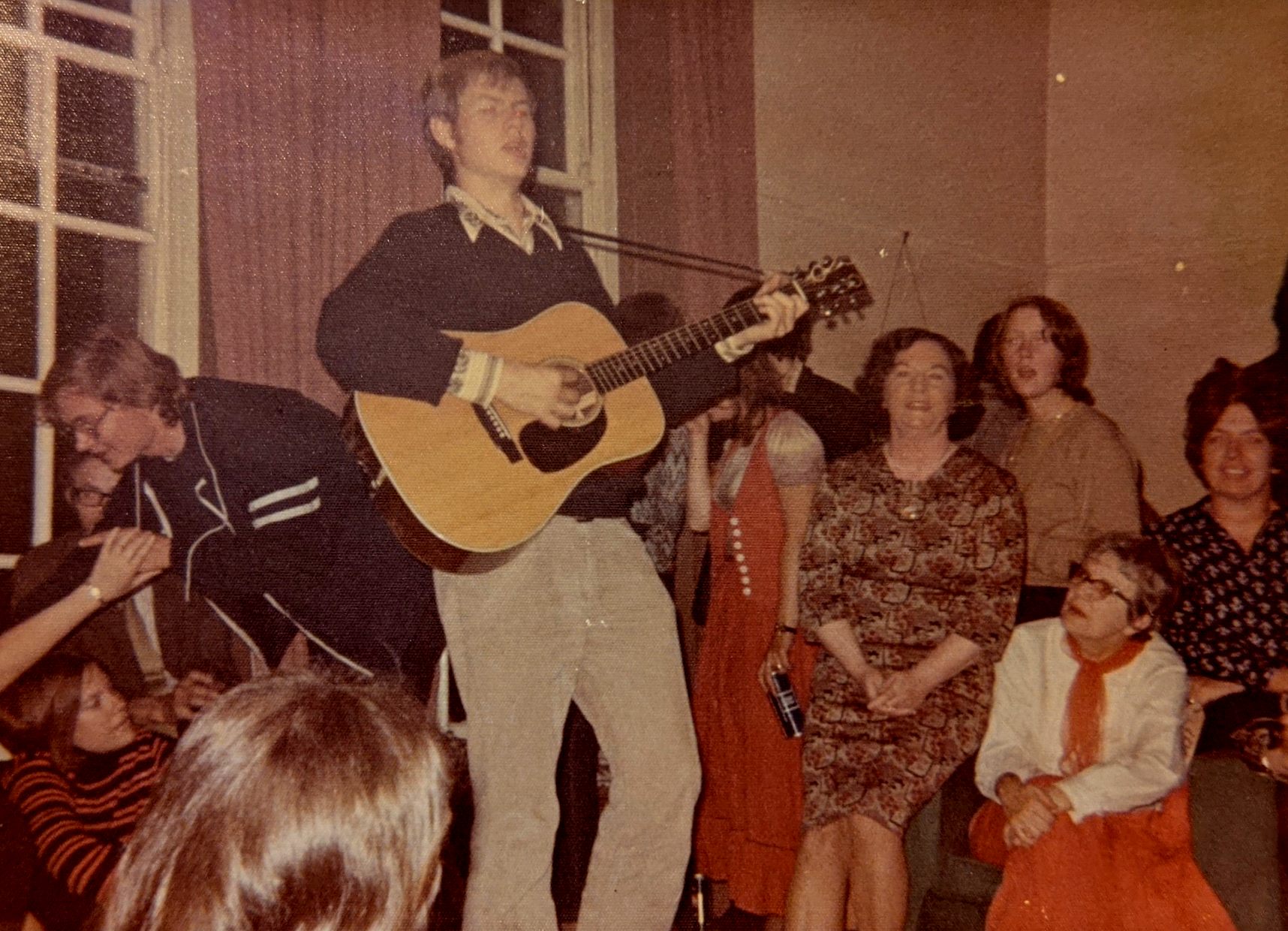
|
When I was in my late teens, already a guitar player several years, one of my teachers introduced me to ragtime. I was quickly enchanted by the music. It had the kind of boldness much like all else I listened to, yet it was also very ambitious and proud. And it was southern, native to the cities along the Mississippi River. As a southerner who grew up feeling that things of value usually came from somewhere else, I felt a little redeemed by it.
At some point the notion began to creep into me that this music was being played on guitar by some people. I was a guitarist and wanted to know more. I was buying Happy Traum guitar lessons sight unseen, and probably picked titles that contained the word "ragtime." I think I came to "Dallas Rag" by this route, which I studied intently. I began to learn the names of the formative ragtime guitarists, quickly singling out Mississippi John Hurt as my favorite.
In the summer of 1971 I had a Navy gig in Newport, Rhode Island. On the way up I spent a few days with my uncle who lived in Greenwich Village in New York—290 West 11th, an address I will never forget. While there I saw Rev. Gary Davis perform at the Gaslight Cafe, but more importantly, I booked a single guitar lesson at Izzy Young's Folklore Center. My teacher was someone named Jack Baker. I probably told him I wanted to learn ragtime guitar and he asked me to play a little of what I knew. I imagine I played "Freight Train," or something similar.
"You've got it all wrong," I remember him saying right away, "you need to start with the alternating bass." He had me play nothing but bass for an eternity. "Then you put the melody on top of that." This simple concept transformed my playing. I reflect on this as one of the important half-hours of my life.
At this point I need to tell two stories somewhat incidental to ragtime. I left New York on a Friday, early afternoon, en route to Newport, arriving that evening. I got on what I think was called the West Side Highway heading north. Rush hour traffic was already thick, stop-and-go as soon as I got on.
I was driving an old MG sports car that broke down in many exotic places. I got as far north as the avenues maybe in the 70s or 80s when suddenly I smelled gasoline. This is dangerous, I thought immediately. I saw an exit just ahead -- do I pull over now or try for the exit? The exit. The pack surged forward, and I got off more quickly than I had expected. I zipped onto the ramp, merged onto an east-bound one-way street, and saw a parking spot on the left. A parking spot! I parked quickly, shut of the engine, and collapsed in a heap of relief against the steering wheel. Still alive.
I looked up and had to laugh: I had evaded a fiery death and found the only free parking spot in Manhattan. Now I was parked right in front of an auto parts store that was open. I got out, opened the hood, and saw a four-inch piece of gas-line with a gash in it, secured by clamps on either end. I unfastened the clamps, slipped off the gas-line, and had the store cut me that length for a couple of bucks at most. I was back on the road in a half-hour.
I would be in Newport for eight weeks. I had long ago calculated that my time there spanned the Newport Jazz Festival and, more importantly, the Newport Folk Festival. This was hallowed ground for me. Something completely impossible, the farthest place on earth measured by my southern longing. Yet there I was.
The Jazz Festival was first. I was less interested in that, but decided to go for Saturday only. Driving over, I was guided to a grassy parking spot, then got out and walked towards the stage. From the distance I could see Dionne Warwick onstage singing "What the World Needs Now, Is Love, Love, Love." I was still a ways from the stage when suddenly she stopped mid-song. There were police, people running. Someone came to the mic and said to go home, the festival was cancelled.
The next day I bought a newspaper, which I still have. Gate crashers. Tear gas. George Wein weeping. And the Folk Festival in jeopardy. For me, the day the music died.
When I returned home to Alabama, the fire inside me had been set. I discovered the album The New Ragtime Guitar, by Dave Laibman and Eric Schoenberg, which was miles ahead of anything else I'd heard. I acquired the score for the "Maple Leaf Rag" and began studying it, trying out different keys and fingerings. I bought piano ragtime albums. I read Rudi Blesch's book, They All Played Ragtime. At some point, with "Maple Leaf Rag" accomplished, I sat down with my tape recorder and just played what I knew, one after another, as best I could. Apparently my dad was in the next room typing. I have no memory of having done this.
What I do remember is that ragtime was for me a solitary pursuit. No one I knew played this music or could talk with me about it. There were no venues where I could perform. My family took no interest in it. I never really felt entitled to play it.
The following summer I acquired a fiddle, which drew me into a rich community and abated the loneliness of ragtime. Suddenly I had access to musical friends, a boundless world of people who shared my yearnings. One year later I could still play only a handful of fiddle tunes. But my friends at Ramblin' Conrad's Guitar and Folklore Center—in Norfolk, Virginia, where I was living—baked me a cake to celebrate my one-year fiddle anniversary.
Fifty years later, I am cleaning out my house preparing to move to France. There, stashed away, was the huge box of tapes I had carried over many moves, not opened since my quarter-inch deck died half that time ago. The ragtime box appeared, more insistent than I was receptive. Did I really do this? There they were, those rags that had consumed my life for a short, intense, and formative time. Could I really hear my treasured "Maple Leaf Rag" arrangement again? I had the tape professionally digitized, which involved all-day low-temperature baking to remove moisture. The pieces on the outer edge of the reel were damaged the most: "St. Louis Tickle" was first, and unfortunately "Maple Leaf Rag" was second. It sounds warbly in spots, but the majesty shines through.
So, this message-in-a-bottle to my future self, what has it said to me about that moment? It reminds me first of the deep insecurities I had, I think related to being a southerner out of my element, that even affected the way I heard musical tones. If I had found this tape much sooner, I might have thought it horrible. And then second it shines a bright light on the deep friendships I developed when I lived in Norfolk and then later in Bloomington and Cincinnati.
Another odd thing: in my whole life, having seen many outstanding guitarists, I don't think I ever heard someone perform a piano rag on guitar. Nor do I know of any recording that took up where The New Ragtime Guitar left off. At the time I made the recording, I am sure I believed that ragtime guitar would evolve and stay always a step ahead of me. I wonder how life would have been if I had only persisted.
Notes to the Songs